
Chasing Jane Austen through 2025
As a tour guide for Hampshire, Jane Austen is one of our biggest characters, indeed heros, in our guided tours. 2025 was a birthday year – happy 250th birthday Jane on 16th December - and as with all TV and film adapted literary giants it was big business and it was a time to celebrate her, although such is her perennial popularity that she always has a dedicated following. Clever, confident, relatable and readable, new for the time and creative – she did so much to develop the idea of the novel we know today. Just like Shakespeare you can always go back to her novels and be inspired again and again. And she did it all without any literary help, money or power and not from London, but rural Hampshire. In her own life she wrested back some agency over her destiny, despite being a powerless, unmarried woman, by writing. And writing like no-one had done before. So where does this brilliant work all come from?
Jane’s life is a bit like one of her novels, although without a happy ending and people find themselves wondering about her life as much as her works. Indeed the life and the novels do overlap in social circumstance, setting, restrictions, personalities and events. Regency England (early nineteenth century), as she describes it, is also a big draw, especially if you’ve seen it come to life in a film adaptation and much of Regency Hampshire is still around to see.
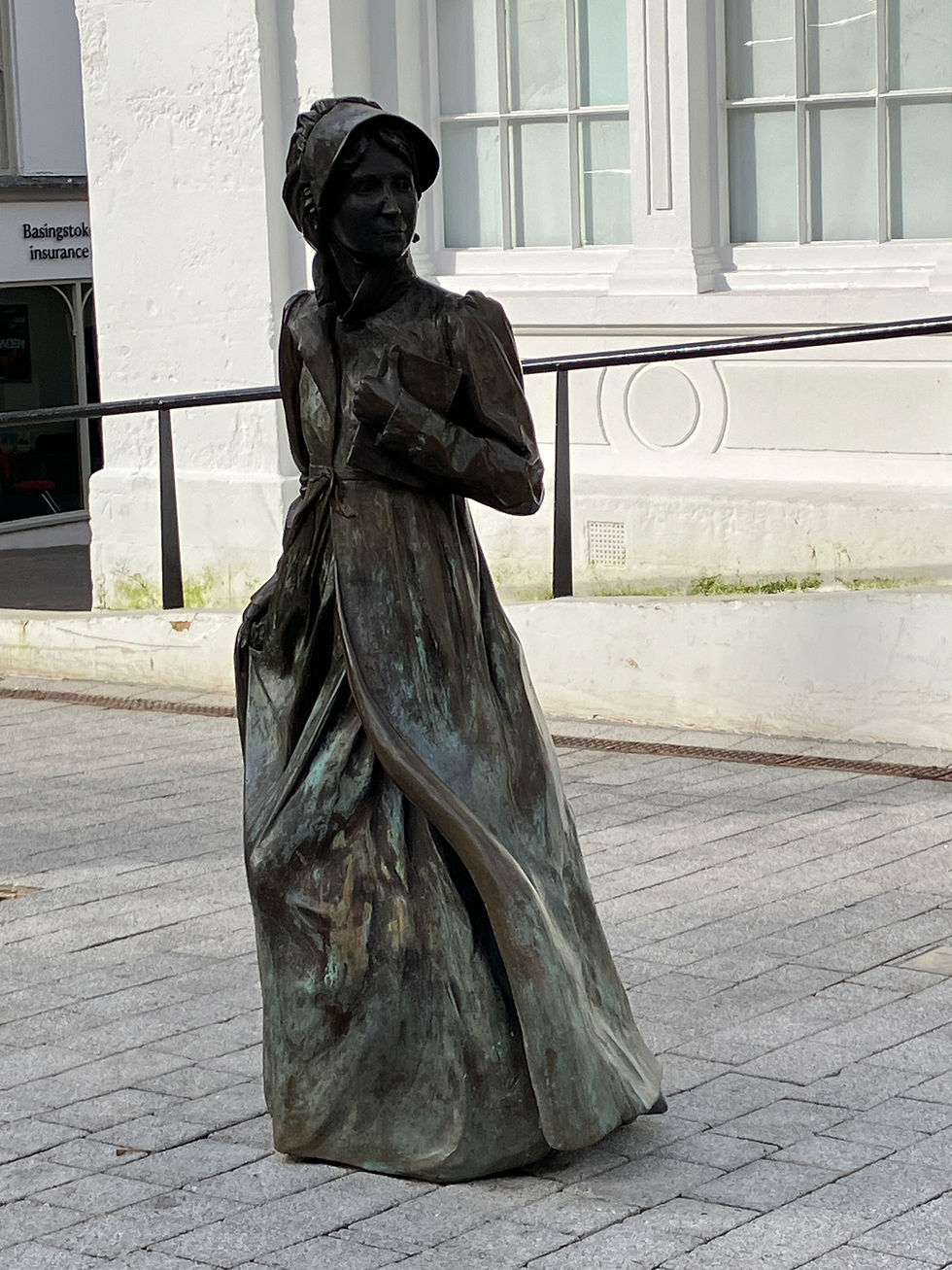
So this year I really upped my Jane Austen game, anticipating new interest. And here are a few things that I did this year, that helped me understand Jane even more and to get an insight into her life, her real life, in Hampshire. And if you like Jane Austen you may like to do this yourself, with or without a guide.
First stop is always Chawton… (but doesn’t have to be)
Chawton and Jane’s cottage there is the most accessible place to visit, because her former home (from 1809-17) is open to the public, restored and run as a museum. It is indeed a good place to understand how she, her other unmarried sister Cassandra, friend Martha Lloyd and widowed mother lived, on the charity of her richer brother, Edward, on his Chawton Estate. And where and how she wrote in that household, at the peak of her literary powers. But you can also see it in combination with Chawton House, the big manor house down the road, also owned by her brother. It’s open to the public and they give guided tours. They also have a library of early women writers there, from which they sometimes run exhibitions, allowing you to see Austen in the context of other writers. This was sometimes lived in by Edward and his family or lived in by members of the Austen family, and other times rented out (Edward’s really big house was in Kent with his other estates). But Jane visited a lot. “I went up to the Gt House between 3 & 4 and dawdled away an hour very comfortably” JA 1814

Jane was often visiting ‘big’ houses, and the contrast with her humble abode gives an insight into the two-sided world she constantly lived in. Gentry, but not rich. Poor, but could not work. As a single woman she lived in gentrified charity, sometimes asked to be a childminder for nieces and nephews in grand houses, dependent on other people’s vehicles to get anywhere. Always a little unsure of her future – she witnessed a Chawton neighbour who was a fallen-on-hard-times spinster who was to be evicted from her cottage. Chawton church is also there, rebuilt since she was there but where her mother and sister were buried. There are other buildings in the village which one can identify from her letters. The booklet ‘Jane Austen and Chawton’ by Jane Hurst available from Alton Museum is very useful. You can tour the village with it.
From Chawton I learnt…the uncertainty of living circumstances, living on charity, the role of the manor house, the social and physical layout of a north Hampshire village, rather like one she had known as a child and young woman…
Steventon
Steventon is the village she was born in, grew up in and lived till she was wrenched from it, unexpectedly, aged 25, with her father’s sudden retirement. Here were other gentry families in the villages and houses nearby and one way to explore the whole spectrum of her life is to walk the area around as Jane did. I knew the ‘Jane life’ sites but walking between them was something new. The Overton Jane Austen trails are a very good way of doing that. Find them here www.overtonjaneaustentrails.org I did the 9 mile walk, which starts in Overton, the large village/small town a few miles from Steventon. In Overton you can see the coaching inns (and post office) on the London Road and the church and house her brother James had when a curate in Overton.

It takes you across field and muddy path to Ashe, another small village where her good friend Madame Lefroy lived at the Parsonage, still there, but a private house and is buried in the graveyard with her husband (and Jane’s niece who also married a Lefroy). Then to Deane, where the Deane Gate Inn would have been, where visitors and mail were collected from the coach stop and where more friends the Lloyds lived and the Harwoods. The Lloyd's house, the Parsonage (also where Jane’s father and mother lived before moving to the Rectory at Steventon) has long gone, but the Harwoods’ Deane House, is still there close to the church. A beautiful house, straight out of an Austen novel, where Jane went to small balls and indeed met one of her amours Tom Lefroy. That romance was forbidden and broken up, Persuasion style, but sadly unlike that novel there was no second chance.

The trail takes you on the road to Steventon, underneath a railway bridge that wasn’t there in Jane’s time, but through mud that probably was. And you get an idea of the walking journeys Jane took to get post and visit friends and the restrictions imposed by weather and season “I enjoyed the hard black frosts of last week very much, & one day while they lasted walked to Deane by myself” JA letter to Cassandra Tuesday 18th December, 1798
“the snow came to nothing yesterday , so I did go to Deane, & returned home at 9 o’clock at night in the little carriage - & without being very cold” JA to Cassandra Wednesday 26th December 1798
At Steventon, most of the village that you see wasn’t the one Jane knew. But you can see the new Rectory house her nephew built in 1824 and the damp field that the old Austen’s rectory was built in. Hence the floods and eventually the rebuild further up the hill. The church is small and isolated and a little walk from the Rectory. The Overton trail takes you back via a distant view of Ashe Park House and the hill, Overton Hill, where Mme. Lefroy fell from her horse after a shopping trip in Overton and died. On Jane’s birthday 16th December 1808. The beauty of the walk is that you see the distances, the views, the conditions underfoot, the amenities, the local farms, the communications, the churches and the circle of acquaintances that made up her whole life for 25 years. The restrictions and the connections. So one can understand that rural, Georgian world of the pseudo-gentry and the houses one lived out one’s hopes in, just like her novels. These are the ‘small worlds’ that Jane had her small powers in and she writes about.

From Overton, Ashe, Steventon and Deane I learnt …about the landscapes, distances, roads, paths, houses, friendships and frailties of life in north Hampshire in a Rectory. The idea of ‘home’ that Jane had but couldn’t hold onto. The young woman’s hopes and where they played out. The background of siblings and childhood playmates. But it wasn’t all rural Hampshire…

Lyme Regis
I was lucky enough to prepare and do a tour on Jane Austen in Lyme Regis this year for the Hampshire Regency Dancers. I thank them for encouraging me to dress up in Regency gear and try Regency Dancing for the first time, it was great fun. Lyme Regis (Jane always called it Lyme) in Dorset, is a wonderful place to visit in its own right and was the home of another Regency hero, Mary Anning, the great fossilist. But Jane visited it as a sea bathing resort in 1803 and 1804. She seemed to love it like no other visit and stayed on when others of her family moved to Weymouth. She rarely describes a real place in her books, but she does describe Lyme in Persuasion.
“the remarkable situation of the town, the principal street almost hurrying into the water, the walk to the Cobb, skirting round the pleasant little bay…The scenes in its neighbourhood, Charmouth, with its high grounds and extensive sweeps of country, and still more its sweet retired bay, backed by dark cliffs, where fragments of low rocks among the sands make it the happiest spot for watching the flow of the tide for sitting in unwearied contemplation”

Lyme still has that affect today. It’s still small and undeveloped. There’s something about it, the coast, the light, the tiny old harbour, the Regency cobb (breakwater) sitting on top of the ancient wall. The little houses and marine villas. And then the gentle air of a forgotten seaside resort with its lodging houses, library, bathing houses, sitting on a medieval port. Many writers seem to react to it, visit and stay – there’s a whole literary story to Lyme. You can visit the Cobb of course, where the fateful scene happens in Persuasion but it is Cobb Gate at the bottom of Broad St., where Jane would have danced at the Assembly Rooms (no longer there), and a good place to see that view she describes – Charmouth to the left, Lyme to the right - is outside the Marine Theatre, which were sea baths in Jane’s day.

Lyme was then a place that was ‘frequented principally by persons in the middle class of life hoping to ‘heal their wounded fortunes’ as Lucy Worsley puts it in her biography and Jane writes in her letter from Lyme that she sees a group of Irish aristocrats in the Assembly Rooms “bold queer looking people, just fit to be Quality at Lyme”.

From Lyme I learnt…the liberation of the sea air and sea bathing in Regency sea resorts. Sitting on the edge of class distinctions even on holiday with the ability and desire to visit a resort but the inability to pay very much. The health-giving effect of Lyme. Lyme as a welcome respite from Bath and a spur to writing.
Portsmouth
You wouldn’t normally associate Jane with Portsmouth, the port city on the south coast of Hampshire, but Portsmouth is Royal Navy and you might just associate Jane with the Navy, if Persuasion is a favourite and particularly if you know two of her brothers were in the Navy. Charles and Francis, the two brothers who came just before and after Jane in age - trained here at the Naval Academy – you can view the building through a fence in Portsmouth Historic Dockyard (it’s still inside the secure part of the Naval Base in Portsmouth, so you can’t visit it).

They will have used the dockyard as their principal port while in the Navy. And the whole Historic Dockyard, which you can visit, is the best preserved Georgian dockyard in the world, which serviced the largest and most successful Navy in the world at the time of Jane Austen.
It is here that you can understand that Jane lived in a country at war (French Revolutionary and Napoleonic). That war was mainly fought at sea and the Royal Navy was a great presence in people’s lives even if you didn’t know anyone in it. But Jane did. She heard about all sorts of global locations from her brothers and about how you worked your way up in the Navy, how you wrote home, could earn your fortune (by taking ships as prizes) and the life lived on board what was one of the greatest working war machines in the world, serviced by a worldwide supply chain and workforce. The story of Admiral Nelson, his ship HMS Victory and his greatest battle Trafalgar, are all told at the Dockyard and were all of Jane’s time and well known. In the ingenious fold-away furniture, convertible facilities and communal living spaces of HMS Victory you can see the practical mind of Captain Harville in Persuasion. The Navy was right on the verge of full industrialisation but was still essentially an incredibly efficient man-powered military juggernaut.

Jane must have visited Portsmouth because her description of the old town is excellent in Mansfield Park. “It was really March; but it was April in its mild air, brisk soft wind, and bright sun, occasionally clouded for a minute; and everything looked so beautiful under the influence of such a sky, the effects of the shadows pursuing each other on the ships at Spithead and the island beyond, with the ever–varying hues of the sea, now at high water, dancing in its glee and dashing against the ramparts with so fine a sound, produced altogether such a combination of charms for Fanny, as made her gradually almost careless of the circumstances under which she felt them.”

From Portsmouth I learnt …the importance of the Royal Navy on the Regency/Napoleonic era mind, the real life of a Navy Officer, experienced by her brothers and Jane’s admiration for Navy officers.
No. 8 College St, Winchester (interior)
There are many sites one can visit in Winchester associated with Jane’s life but this one was new and exciting and may not be repeated. But I got the chance in June 2025 when it was opened by the owners, Winchester College. A small house, which Jane and Cassandra rented and lived in for a few weeks, while Jane saw a Winchester doctor, Dr. Giles Lyford. I know this building from the outside as it forms part of our usual Winchester guided tours, but it had been empty for years and I had never been inside. This year they opened it for a few days.


Seeing the rooms where Jane spent her last weeks and indeed died, certainly made me contemplate and mourn her death even more closely. They were also the rooms in which Cassandra her dearest sister, comforted her at her death and then grieved in, as she saw her for the last time “I watched the little mournful funeral procession the length of the Street & when it turned from my sight & I had lost her for ever…even then I was not overpowered…”. I re-read the letters sent by Cassandra after Jane’s death from that house. I also went on my friends’, the Winchester Tourist Guides, ‘My Dear Cassandra’ costumed tour, which if run again in future years I would highly recommend. It is not entirely focused on that moment, but had a crescendo outside No. 8. I also studied the poem, Venta, Jane wrote there on 15th July 1817, St Swithun’s Day, three days before her death. It mentions so much of the history of Winchester, in a mocking way, that you know that she knew this city and this street, with William of Wykeham’s school next door and the Bishops Palace at the end. Both mentioned in the poem. St Swithun and Wykeham both buried in the Cathedral, as of course Jane eventually was.
From 8, College St I learnt…how strong the sisterly love was between Jane and her sister Cassandra and how much a part of each of their lives the other was. How they faced the world together, understood each other and how large the loss must have been when Jane died prematurely. They did not even know what illness it was that killed her. But also that Jane loved the Cathedral and so although an unusual burial place, perhaps a happy one in the heart of Hampshire.
Like Shakespears Jane is for all time, not just birthday years, so if you’re interested in Jane Austen and visiting Hampshire, I do guided tours of Jane’s Winchester and the other Hampshire sites, as well as Lyme Regis or Portsmouth with or without a Jane theme. We take in Regency era life, architecture, society as well as the details of Jane and her family and friends and books. Get in touch if you’d like to join me.


Comments